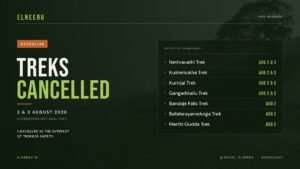
On April 17, 2026, Karnataka Forest Minister Eshwar Khandre announced a new Standard Operating Procedure (SOP) for trekking across forest areas in the state. The move comes after a series of incidents involving trekkers getting lost, including a widely reported case near Tadiandamol where a trekker was stranded for days before rescue.
The Karnataka Forest Department (Karnataka Forest Department) has framed these rules as a safety and conservation measure. However, the response from the trekking community has been sharply divided.
This article breaks down the announcement, captures real public sentiment, and examines what this means going forward.
What the New SOP Says
The new SOP introduces structural changes to how trekking is allowed in forest regions.
Mandatory Nature Guides
- Trekking is not allowed without a certified nature guide
- One guide is required for every 10 trekkers
- Solo trekkers must also be assigned a guide
This effectively removes the option of independent trekking in these zones.
GPS Monitoring and Safety Protocols
- Guides must carry GPS-enabled walkie-talkies
- Mandatory check-ins with base camp every 30 minutes
- Trekkers are required to install a tracking mobile application
- If no communication is received for one hour, a search operation is triggered
This introduces a centralized monitoring system for all trekkers.
Capacity and Time Restrictions
- Maximum of 150 trekkers per route per day
- Night trekking is banned
- All treks must be completed before sunset
- Total trekking distance capped at 19 km (round trip)
These limits are intended to control footfall and reduce risk exposure. This directly impacts longer and flexible treks like Kumara Parvatha.
Health and Compliance Rules
- Trekkers above 60 must provide a fitness certificate
- Minors require written parental consent
- Violations can lead to permanent blacklisting
Environmental Regulations
- “Carry in, carry out” waste policy
- Ban on plastics, loud music, flash photography, campfires, and weapons
The environmental focus is on minimizing human impact in sensitive forest zones.
Why This SOP Was Introduced
The decision follows multiple incidents of trekkers getting lost or stranded in forest regions. Rescue operations in such terrains are resource-intensive and often delayed due to lack of real-time tracking.
Recent cases, including the Tadiandamol incident, have highlighted gaps in:
- Trekker preparedness
- Communication systems
- Emergency response timelines
The SOP attempts to address these issues through mandatory supervision and tracking.
Public Reaction: A Divided Response
Social media reactions reflect a clear split between those who support regulation and those who see it as overreach.
Concerns Around Freedom and Independence
A large section of trekkers feel that the rules take away the core essence of trekking:
“Because of a few people getting lost, they’ve made it illegal for everyone to explore on their own.”
“Some people want to enjoy nature in solitude. That’s not possible anymore.”
For many, trekking is associated with independence and minimal interference, which this SOP directly impacts.
Fear of Increased Costs
Another major concern is financial:
“This is just a way to increase guide fees and entry costs.”
“Guides will still ask for extra ‘tea-coffee’ money.”
Trekkers are skeptical about how pricing will be regulated and whether costs will become unpredictable.
Implementation Doubts
There is also skepticism about execution:
“How will they enforce this in deep forest areas?”
“Are they going to station people at every trailhead?”
Given existing challenges in managing large crowds in other public spaces, many question whether this system can be consistently enforced.
Support for Conservation and Safety
At the same time, a significant group supports the move:
“This is how trekking should be regulated, especially on overused trails.”
“Preservation should come before tourism.”
“Having guides will reduce littering and improve safety.”
Some also point out that similar systems exist in countries like Nepal, where guided trekking is standard practice.
Debate Around “Commodification of Nature”
A recurring theme is whether this policy turns nature into a paid experience:
“People found a hobby that was free, now it’s being monetized.”
“This feels like gatekeeping access to nature.”
Others counter that structured access is necessary to protect ecosystems from overuse.
Ground Reality: What Changes for Trekkers
Regardless of opinion, the practical impact is clear:
- Solo trekking in forest areas is no longer possible without a guide
- Spontaneous plans will be harder due to daily caps
- Costs may increase, especially for low-footfall treks
- Compliance requirements will add friction to the process
At the same time:
- Safety mechanisms are significantly stronger
- Rescue response times are likely to improve
- Environmental damage may reduce if rules are enforced
Travel Elneeru’s View
From an operational perspective, this SOP is a structural shift rather than a temporary restriction.
There are two clear outcomes:
- Trekking becomes more organized
- Access becomes limited and regulated
The introduction of mandatory guides also creates a more stable income stream for local communities. Previously, guide fees varied widely depending on demand and negotiation. A standardized system can bring consistency if implemented correctly.
However, one challenge is evident:
For treks with low footfall, solo trekkers may end up bearing the full cost of a guide, which can discourage participation. A possible solution already discussed in operational circles is grouping or batching smaller bookings into standard groups of 10, especially on popular routes. This can balance cost and compliance.
What This Means Going Forward
This SOP is likely to:
- Reduce overcrowding on popular trails
- Shift trekking from unplanned activity to scheduled experience
- Increase the role of organized operators in managing logistics
Trekkers who rely on last-minute or independent plans may find access more difficult.
Those who plan in advance and use structured systems are less likely to face disruptions.
The Transition Phase
In the short term, there will likely be:
- Confusion around implementation
- Variability in enforcement across regions
- Pricing inconsistencies
Over time, the system is expected to stabilize as:
- More guides are certified
- Processes become standardized
- Demand and supply adjust
Conclusion
The Karnataka trekking SOP marks a clear shift in how access to forest trails is managed.
It introduces:
- Mandatory supervision
- Technology-driven safety
- Strict environmental controls
Public opinion remains divided, with valid arguments on both sides—ranging from loss of freedom to the need for conservation and safety.
For trekkers, the key change is not just the rules themselves, but the move toward a more structured trekking ecosystem.
How smoothly this transition works will depend largely on execution—both by authorities and by the operators facilitating these experiences.