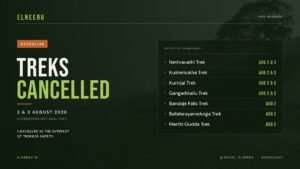
Daily monitoring of the Karnataka Forest Department’s Aranya Vihaara online booking portal provides concrete data on how permits for the Nethravathi Trek in Dakshina Kannada are claimed over time. Over a sample of 123 tracked dates, our recorded observations show the precise rate of permit uptake, allocation exhaustion, and booking windows. These figures reflect our daily tracking entries over 123 dates, though the official Aranya Vihaara portal remains the final authority for permit availability on any individual date.
Summary of Tracked Data
The Nethravathi Peak trail operates under a strict daily quota set by the Karnataka Forest Department. Across the 123 dates recorded in our dataset, overall permit uptake demonstrates consistent demand across the calendar.
- Trek Location: Nethravathi Trek (Dakshina Kannada)
- Daily Permit Quota: 300 permits issued per day
- Tracked Duration: 123 dates
- Average Fill Rate: 82.6% across all tracked dates
- Time to Reach 80% Capacity: 12.2 days on average
- Fully Booked Dates: 98 out of 123 dates
Permit Uptake Rate and Lead Times
The tracking data indicates that Nethravathi is a trek that frequently reaches full allocation capacity. Out of 123 tracked days, 98 dates reached 100% permit uptake (300 out of 300 permits issued). This shows that 79.7% of all recorded dates were fully booked before trail access opened on those days.
For dates that reached high capacity, the average lead time for a given date to hit 80% fill (240 out of 300 permits taken) was 12.2 days prior to the trek date. Trekkers planning to secure slots must account for this timeframe, as permit availability drops significantly roughly two weeks ahead of time. Understanding these patterns is useful when reviewing general Aranya Vihaara booking guidelines and broader permit procedures covered in our Karnataka trek permits guide.
Current Availability Status (As of 06 September 2026)
A snapshot of the Aranya Vihaara portal recorded on 06 September 2026 illustrates how quickly upcoming dates fill up over a twelve-day forward window. Nine consecutive days are completely sold out, with partial availability remaining on select mid-week dates.
- 07 Sep 2026: 300 of 300 permits taken (100% full)
- 08 Sep 2026: 300 of 300 permits taken (100% full)
- 09 Sep 2026: 300 of 300 permits taken (100% full)
- 10 Sep 2026: 300 of 300 permits taken (100% full)
- 11 Sep 2026: 300 of 300 permits taken (100% full)
- 12 Sep 2026: 300 of 300 permits taken (100% full)
- 13 Sep 2026: 300 of 300 permits taken (100% full)
- 14 Sep 2026: 300 of 300 permits taken (100% full)
- 15 Sep 2026: 300 of 300 permits taken (100% full)
- 16 Sep 2026: 137 of 300 permits taken (46% full)
- 17 Sep 2026: 186 of 300 permits taken (62% full)
- 18 Sep 2026: 300 of 300 permits taken (100% full)
Analysis of Trail Demand Patterns
The status report as of 06 September 2026 shows zero permit availability from 07 September through 15 September inclusive. All 300 daily permits for each of those nine days have been allocated. On 16 September, 137 of 300 permits are taken (46% full), while on 17 September, 186 of 300 permits are taken (62% full). Demand returns to maximum capacity on 18 September, which is already 100% full with 300 of 300 permits taken.
Across the entire dataset of 123 dates, the average occupancy rate sits at 82.6%. This indicates that even dates that do not reach complete exhaustion typically absorb over four-fifths of their total daily quota. The 80% occupancy mark is reached at an average of 12.2 days before the scheduled trek date, confirming that late bookings on this trail carry a low likelihood of success.
Practical Guidance for Applicants
When applying for permits on the official portal, applicants should evaluate dates at least 12 to 14 days in advance. Because 98 out of 123 tracked dates reached total exhaustion, waiting until the final week before departure frequently leaves applicants without valid slots. On dates such as 16 September and 17 September, where fill rates currently stand at 46% and 62% respectively, remaining permit inventory decreases continuously as the date approaches.
Elneeru tracks these metrics continuously to manage operational scheduling for guided groups on the trail. While these recorded figures provide an empirical baseline across 123 tracked dates, real-time permit issuance remains governed strictly by active transactions on the Karnataka Forest Department portal.